
“Sleep is not a luxury; it is a biological necessity for emotional, psychological, and physical well-being.”
Introduction
As we begin the year 2026, many individuals set goals related to productivity, mental clarity, emotional balance, and physical health. Yet one foundational pillar often overlooked is sleep health. Abnormal sleep patterns—commonly referred to as sleep disturbances or sleep disorders—are increasingly prevalent and closely linked to mental health challenges, relational difficulties, academic struggles and reduced work performance.
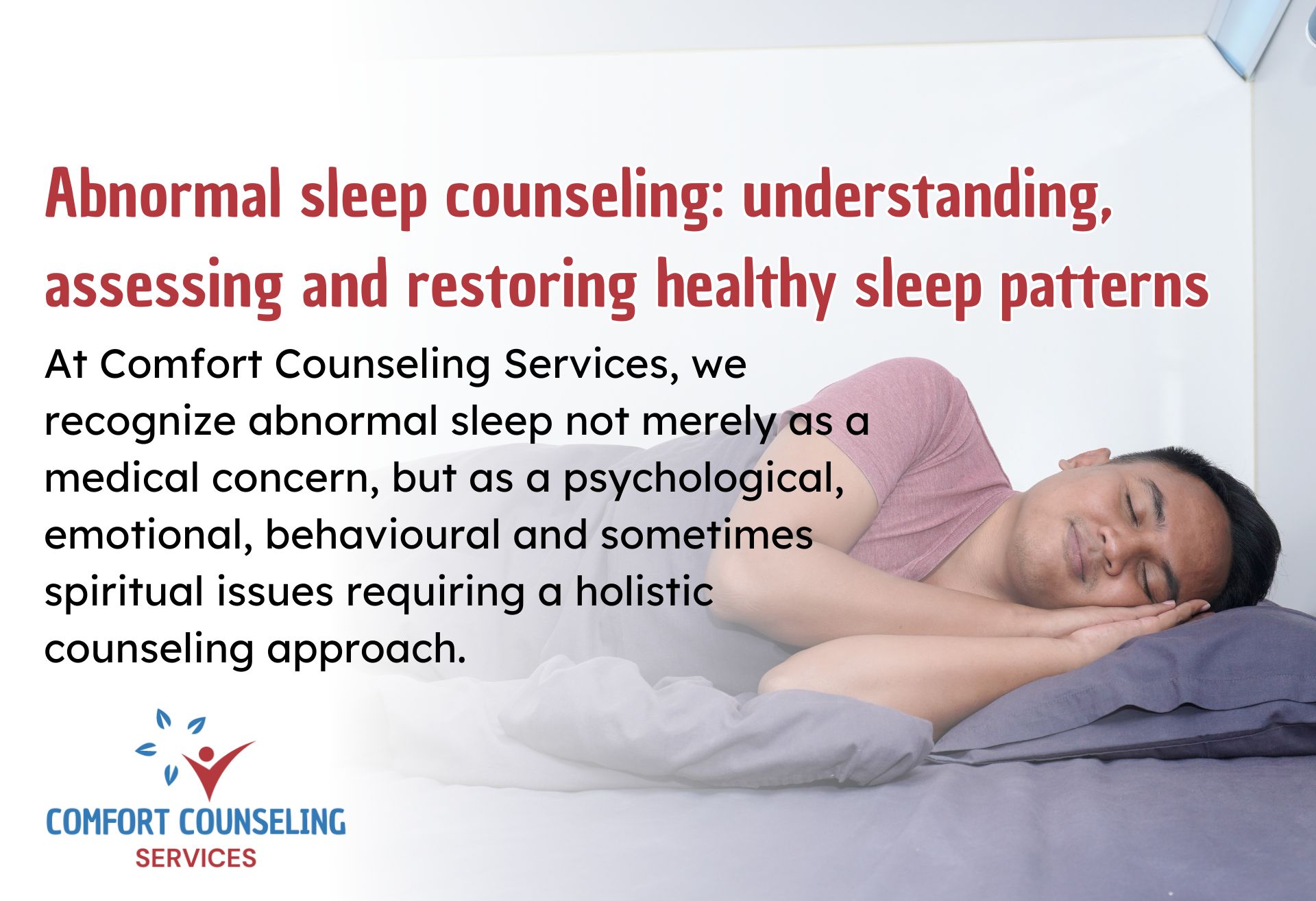
At Comfort Counseling Services, we recognize abnormal sleep not merely as a medical concern, but as a psychological, emotional, behavioural and sometimes spiritual issues requiring a holistic counseling approach. This January, we focus on Abnormal sleep counseling, equipping individuals, families, and organizations with understanding and pathways to restoration.
Understanding abnormal sleep
What Is abnormal sleep?
Abnormal sleep refers to persistent disturbances in sleep quality, duration, timing or behaviour that impair daily functioning (American Psychiatric Association [APA], 2022). These disturbances may be episodic or chronic and often coexist with psychological or emotional distress.
Common types of abnormal sleep
- Insomnia disorders – Difficulty initiating or maintaining sleep
- Hypersomnia – Excessive sleepiness despite adequate sleep
- Circadian rhythm sleep-wake disorders – Misalignment between internal clock and environmental demands
- Parasomnias – Nightmares, night terrors, sleepwalking
- Sleep-related anxiety – Fear or hyperarousal associated with bedtime
- Trauma-related sleep disturbances – Recurrent nightmares and fragmented sleep
(APA, 2022; Morin & Benca, 2012)
Psychological and emotional roots of abnormal sleep
Research consistently demonstrates that abnormal sleep is both a cause and consequence of psychological distress.
Key contributing factors
- Chronic stress and anxiety disorders (Harvey, 2008)
- Depression and mood disorders (Baglioni et al., 2016)
- Unresolved trauma and grief
- Maladaptive coping mechanisms
- Excessive cognitive rumination
- Attachment-related anxiety
- Digital overexposure and screen dependency
Sleep disturbances often become conditioned responses, where the bed itself triggers anxiety, leading to a self-perpetuating cycle of poor sleep and emotional dysregulation.
Impact of abnormal sleep on mental health
Abnormal sleep significantly affects:
- Emotional regulation
- Impulse control
- Memory and concentration
- Decision-making
- Interpersonal relationships
- Spiritual vitality
Longitudinal studies indicate that persistent insomnia increases the risk of depression, anxiety disorders, substance misuse, and suicidal ideation (Baglioni et al., 2011; Freeman et al., 2017).
Abnormal sleep across the lifespan
Children and adolescents
- Nightmares, bedtime resistance, anxiety-related insomnia
- Often linked to family stress, academic pressure, or trauma exposure
Adults
- Stress-related insomnia, burnout-induced sleep fragmentation
- Work-life imbalance and caregiving stress
Older adults
- Advanced sleep phase disorders
- Sleep disruptions linked to medical conditions and loneliness
(Mindell et al., 2015)
Counseling Approaches to Abnormal sleep
At Comfort Counseling Services, abnormal sleep counseling is integrative, evidence-based, and client-centered.
1. Cognitive Behavioral Therapy for Insomnia (CBT-I)
CBT-I is the gold standard psychological treatment for insomnia, addressing:
- Dysfunctional sleep beliefs
- Sleep-related anxiety
- Behavioral patterns reinforcing insomnia
(Morin et al., 2015)
2. Trauma-informed sleep counseling
For clients with trauma histories:
- Gentle processing of night-related fear
- Grounding techniques
- Narrative restructuring
- Safe-body interventions
(van der Kolk, 2014)
3. Emotional regulation and stress counseling
Counseling helps clients:
- Identify stress triggers
- Develop relaxation and containment skills
- Reduce hyperarousal before sleep
(Harvey & Tang, 2012)
4. Lifestyle and behavioural interventions
Counselors guide clients in:
- Sleep hygiene restructuring
- Digital detox routines
- Establishing circadian consistency
- Boundary setting around rest
5. Faith-sensitive and holistic counseling (where appropriate)
For clients who desire it, counseling may incorporate:
- Meaning-making
- Spiritual coping resources
- Values-based rest practices
- (Pargament, 2011)
Assessment in abnormal sleep counseling
Professional assessment includes:
- Clinical interviews
- Sleep diaries
- Psychological screening tools
- Stress and trauma inventories
- Collaboration with medical professionals when necessary
This ensures accurate differentiation between psychological, behavioural and physiological contributors.
When to seek counseling for sleep problems
Consider professional counseling if sleep difficulties:
- Persist beyond 3–4 weeks
- Interfere with work, school, or relationships
- Are accompanied by mood changes or anxiety
- Involve recurrent nightmares or fear of sleep
- Do not improve with self-help strategies
The role of counseling in sustainable sleep recovery
Medication may offer temporary relief, but counseling addresses the root causes of abnormal sleep—thought patterns, emotional wounds, behavioural conditioning and unresolved stress.
Evidence shows that counseling-based interventions produce long-term improvements in sleep quality and mental health outcomes (Morin et al., 2015).
Comfort Counseling Services’ commitment
Since 1994, Comfort Counseling Services has provided professional, ethical, and compassionate counseling across Kenya and internationally. Our abnormal sleep counseling services are offered to:
- Individuals
- Couples and families
- Children and adolescents
- Faith-based and corporate organizations
We believe restoration of sleep is restoration of life balance.
Conclusion
As we step into 2026, let us redefine rest not as idleness, but as intentional healing. Abnormal sleep is not a personal failure—it is a signal inviting care, insight, and professional support. Counseling provides the tools to reclaim rest, resilience, and renewed emotional strength.
References
American Psychiatric Association. (2022). DSM-5-TR: Diagnostic and statistical manual of mental disorders (5th ed., text rev.).
Baglioni, C., et al. (2011). Insomnia as a predictor of depression: A meta-analytic evaluation. Journal of Affective Disorders, 135(1–3), 10–19.
Baglioni, C., et al. (2016). Sleep and mental disorders: A meta-analysis. Psychological Bulletin, 142(9), 969–990.
Freeman, D., et al. (2017). Sleep disturbance and psychiatric disorders. The Lancet Psychiatry, 4(7), 558–568.
Harvey, A. G. (2008). Insomnia, psychiatric disorders, and the transdiagnostic perspective. Current Directions in Psychological Science, 17(5), 299–303.
Harvey, A. G., & Tang, N. K. Y. (2012). Cognitive behavior therapy for insomnia. Sleep Medicine Clinics, 7(3), 377–386.
Mindell, J. A., et al. (2015). Sleep disorders across the lifespan. Sleep Medicine Reviews, 22, 44–58.
Morin, C. M., & Benca, R. (2012). Chronic insomnia. The Lancet, 379(9821), 1129–1141.
Morin, C. M., et al. (2015). Psychological and behavioral treatment of insomnia. Sleep, 38(6), 921–938.
Pargament, K. I. (2011). Spiritually integrated psychotherapy. Guilford Press.
van der Kolk, B. (2014). The body keeps the score. Viking.